

Welcome
Welcome to this guide.
For nearly every dance school, "SEO" really means showing up in your own town. This guide is the playbook for winning that local game.
Most studio owners hear the words SEO and either glaze over or hand it to a freelancer who returns a 40-page audit nobody reads. That is a shame, because the bits that actually matter for a local studio are not technical. They are stubborn, repeatable habits any owner can run themselves.
By the end of this guide you will know what to fix on your Google Business Profile this week, the website pages that quietly win local searches, how to gather reviews without feeling pushy, and the three numbers worth watching every month.
How to use this guide
Read it through once with a coffee, then come back to it. The worksheets are designed to be marked up. The 30-day sprint at the end is the fastest route from "I should sort our SEO" to "we are climbing the map pack".
Who this is for
- Studio owners who want more enquiries from Google without paying for ads
- Schools whose Google profile has been on autopilot for years
- Marketing leads at growing studios with more than one venue
- Anyone who has ever Googled their own school and been disappointed
Contents
What's inside.
Part One
The Foundation
Google's local results are not magic. They reward complete profiles, fresh activity and a steady drip of real reviews. Start here.
Chapter 01
Why local SEO is your highest-leverage channel.
Most enquiries do not begin with a website. They begin with a search on a phone at the kitchen table.
A parent decides their seven-year-old wants to try ballet. They reach for the phone. They type "ballet classes near me" or "dance school in Tonbridge". Three results appear on a little map. They tap one. They scroll. They tap call, or they tap directions. That entire sequence takes less than a minute, and your studio either exists in it or it does not.
Why this beats almost everything else
- Intent. Someone searching "tap classes in Kingston" is two questions away from booking.
- Free. The map pack is not pay-per-click. You earn it.
- Compounds. Reviews, photos and citations stack year on year.
- Local moat. Once you're number one in your town, it is genuinely hard to dislodge you.
Mindset shift
Stop thinking of Google as something the marketing person worries about. Your Google Business Profile is the digital front door of your studio. Treat it with the same care as the actual front door.
Chapter 02
The local search landscape.
When a parent searches for a dance class, Google shows three different things in three different boxes. Knowing which is which changes how you compete.
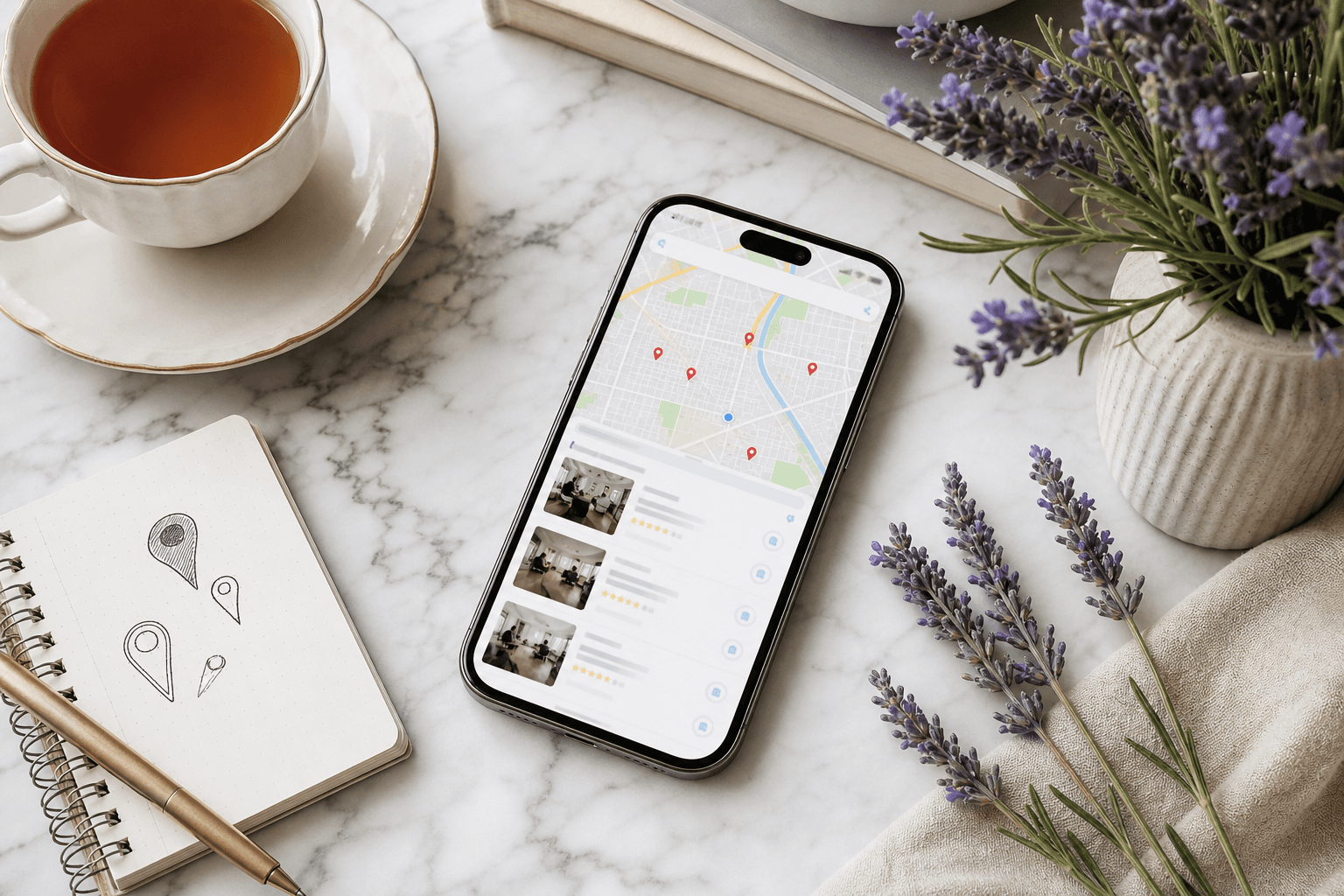
The three layers of a local search
- Paid results. Google Ads at the very top, usually marked "Sponsored". Pay-per-click. Not what this guide is about.
- The map pack. Three businesses pinned on a map with names, ratings and distance. The prize. Most booking-ready parents tap something here first.
- Organic results. The blue-link results below the map. Your website pages, blog posts and directory listings live here, and they feed the map pack.
What Google weighs (in plain English)
Relevance
Does your profile clearly say you teach dance, in this town, to these ages?
Distance
How far you are from the searcher. You cannot change this, but you can make the rest count more.
Prominence
How established and trusted you look. Reviews, real photos, mentions, fresh activity.
Chapter 03
Anatomy of a complete Google Business Profile.
A complete profile out-ranks a half-finished one. Fill in everything, then fill in the bits you missed.
The fields that move rankings
- Primary category. "Dance school", not "performing arts" or "after-school activity". Specific wins.
- Additional categories. Up to nine. Add the genres you teach: ballet school, modern dance, tap dance studio.
- Business name. Your real name. Never stuff keywords; Google penalises it and it looks naff.
- Address or service area. Real address if parents come to you. Service area if you use hired halls.
- Hours. Trading hours plus "special hours" for half-term and Christmas.
- Description. 750 characters. Town, disciplines, ages, what makes you different. Sound human.
- Services. Every class type, with age range. Ballet 3-6, Ballet 7-11, Adult tap.
- Attributes. Wheelchair access, parking, online classes, women-led. Tick what's true.
Quick profile audit
- Every category is set, with the most specific one as primary
- The description names the town and disciplines in the first two sentences
- Services include every class type, with age ranges
- At least 20 photos, none older than 18 months
Chapter 04
Photos and posts that move the needle.
Google rewards profiles that look alive. Photos and posts are how you prove yours is.
Photos: a small, useful library
- Exterior. So parents can recognise the building from the pavement.
- Interior. Studio floor, sprung wood, mirrors, a barre. Reassurance.
- In action. Real students in class, with consent. Joy beats polish.
- Team. Friendly portraits of the people who teach.
- Logo. A clean square version on a white background.
Aim for 30 to 50 photos in total. Add three or four a month so the profile keeps signalling activity. Tag them with location data if your camera supports it.
Posts: little, often, useful
What to post
Class start dates, new teachers, exam results, performance dates, holiday courses, trial-class call-outs.
How often
One post a week is plenty. The aim is consistent freshness, not volume. Add a photo and a call to action every time.
Five-minute habit
Block out fifteen minutes every Monday. Add one photo, write one post, reply to any new reviews. Set a recurring calendar invite. That single habit beats every "SEO strategy" most studios have ever tried.
Chapter 05
Reviews as the SEO engine.
Reviews are the single biggest lever you have. They affect rankings, they reassure parents, and they cost nothing to gather.
The four numbers Google reads
Volume
Total review count. More is better, but the gap between you and the local average matters most. Aim to be above it.
Average rating
Anything 4.6 and above is healthy. Below 4.2 starts to hurt. One or two genuine bad reviews is normal; ignore the urge to panic.
Recency
A profile with reviews from last week beats one with 200 reviews from 2019. Steady drip beats a binge.
Keywords
When parents naturally mention "ballet", "Kingston", "first class", "my daughter", you get small relevance boosts. You cannot fake these — they come from real reviews.
What good looks like for a UK studio
Facebook recommendations are useful for trust but barely register for SEO. Google reviews are the only ones that change your map-pack ranking.
Chapter 06
Asking for reviews without feeling weird.
Most parents are happy to leave a review. They just need a moment of prompting and a link that works first time.
The three moments to ask
- 01
After a successful trial
Twenty-four hours after the trial, while the warmth is still in the air. Email or WhatsApp. Personal, brief, low pressure.
- 02
At the end of every term
A short email to the whole parent body. "If your child has enjoyed this term, a Google review would mean the world." Most reviews come from this one prompt.
- 03
After a milestone
Exam result, first show, summer school. Catch the moment a parent already wants to thank you and turn it into a review.
A short, kind script that works
Copy and adapt
"Hi [name], thanks for trusting us with [child] this term. If you have two minutes, a Google review would really help other parents who are weighing us up. Here is the direct link: [your short link]. Either way, see you next week."
Make it one tap
- Generate your short review URL inside Google Business Profile (it looks like g.page/r/...)
- Save it as a saved reply in your phone, in WhatsApp, and on a sticker at reception
- Make a QR-code poster for the changing room wall. Surprisingly effective.
- Never offer discounts or free classes in exchange — it is against Google's rules and it shows
Chapter 07
Replying to reviews well.
Every reply you write is read by ten future parents. Treat them as small pieces of marketing.
Replying to a five-star review
- Thank them by name, never "dear customer"
- Reference what they said (their child, the class, the teacher)
- Naturally include a keyword once: "so glad [child] is enjoying ballet at our Tonbridge studio"
- Keep it short. Three sentences is plenty.
Replying to a difficult review
- 01
Wait an hour
Never reply when your heart is pounding. The internet is forever. An hour rarely makes the situation worse.
- 02
Acknowledge, do not argue
"We're really sorry your experience didn't match what we aim for." You don't have to agree to be gracious.
- 03
Move it offline
"Please email me directly at [your name]@... so I can look into this properly." Future readers see a studio that takes things seriously.
- 04
Resist the urge to defend in public
Long defensive replies make every reader uncomfortable. Short and human wins.
The 24-hour rule
Reply to every review within 24 hours. Google notices reply rate and speed. Parents notice the warmth. Both compound.
Part Two
Your Website's Role
Your Google profile and your website are a pair. Each one reinforces the other. Here is how to make the website pull its weight.
Chapter 08
Location pages on your website.
If you teach in more than one venue, you need more than one page. One combined "locations" list will never out-rank a real, dedicated page.
What belongs on a location page
- The venue's full address, with a clickable Google Maps link
- Photographs taken at that specific venue, not a generic studio shot
- Which classes run there, on which days, with which teachers
- Parking, drop-off, public transport notes (genuinely useful, not filler)
- A trial-booking button that pre-fills the venue field if possible
- Two or three reviews specifically from parents at that venue
Title and headings
Page title (in the browser tab)
"Ballet, Tap & Modern Classes in Tunbridge Wells — [Studio Name]". Specific, geographic, descriptive.
Main H1
"Dance classes in Tunbridge Wells". One H1 per page. The town goes in it. Naturally, not stuffed.
Do not copy-paste the same paragraphs across location pages with just the town swapped. Google spots near-duplicate content. Write fresh, even if just three paragraphs each.
Chapter 09
Local citations and mentions.
Citations are simply other places online that name your studio, address and phone number. Google treats each one as a small vote of confidence.
Where to be listed
- Yell.com. Old but still indexed.
- Bing Places. Tiny share, free, worth ten minutes.
- Apple Maps. Increasingly used on iPhones.
- Facebook Page. Address and hours filled in.
- NetMums or Mumsnet local. High parent intent.
- Your local council. Activities pages, town directories.
- School newsletters. Ask, don't wait.
- Church and village halls. Where you teach.
- Local press. A free "new term" story works.
- Dance bodies. ISTD, RAD, IDTA, Move It directories.
How to do it without losing a weekend
- 01
Write your details once
Open a notes file. Studio name (exactly as on GBP), address, phone, email, website, 50-word and 150-word descriptions. Copy from this every time.
- 02
Set aside two hours
One sitting, one cup of tea. Power through the list. Done is better than perfect.
- 03
Diarise an annual review
Once a year, check every listing for accuracy. Phone numbers change, hours change, websites move.
Chapter 10
NAP consistency.
NAP stands for Name, Address, Phone. Google is fussy about getting the same trio in the same format everywhere. Inconsistency confuses it, and confused Google ranks you lower.
The exact-match rule
Pick the format you want and stick to it, full stop. "St." or "Street". "&" or "and". "Limited" or "Ltd". A capital letter or not. Every directory entry, your website footer, your GBP, your invoices, all the same.
Common slip-ups we see
Two phone numbers
A landline on Yell, a mobile on Facebook, a third on the website. Choose one primary. Forward the others if needed.
Old addresses
You moved studio in 2022 but three directory listings still show the old address. Hunt them down.
Punctuation drift
"Sarah's School of Dance" vs "Sarahs School of Dance". The apostrophe matters.
Different trading names
"Tonbridge Dance Academy" on one site, "TDA Dance" on another. Pick one. Re-use it.
Ten-minute job
Google your own studio name. Click the first ten results. Note any listing where your name, address or phone is wrong, missing or out of date. Fix one a day for a fortnight.
Chapter 11
Schema markup made simple.
Schema is a small bit of code that tells Google, in its own language, what your business is. You don't need to read code to get the benefit.
What it does, in one paragraph
When Google's robots read your homepage they have to guess what's a class, what's a price, what's a review. Schema removes the guesswork. The result: richer search listings (star ratings, prices, opening hours) and a small ranking nudge.
What to add for a dance school
- LocalBusiness (or DanceSchool) — name, address, phone, hours, geo-coordinates
- AggregateRating — your average rating and review count from Google
- FAQPage — on your FAQ or trial-day page, the questions and answers
- Event — for shows, exam dates and holiday courses
- Course — for each class type you offer
How to add it without learning to code
- 01
Use a generator
Tools like Schema App, RankMath or Yoast Local plug into WordPress and generate the markup from a form. If you use a modern bespoke site, your developer can drop it in once and forget.
- 02
Test it
Paste your homepage URL into Google's Rich Results Test (search.google.com/test/rich-results). It tells you what worked and what didn't.
- 03
Don't over-mark
Only mark up what is genuinely true and visible on the page. Lying with schema is a fast route to being demoted.
Chapter 12
Local content that earns you links.
The cheapest, most ethical way to climb local rankings is to be genuinely useful to your town. Then to mention it on your website.
Five content ideas that work for dance schools
- 01
A round-up of family things to do in [your town]
Soft, friendly, useful. Other businesses link to it. Mums groups share it. The kind of post that earns you fifty good links over five years.
- 02
"What to expect at your first ballet class in [town]"
Targets a specific search a real parent makes. Answers it properly. Photos from your own studio. Trial CTA at the end.
- 03
Local exam results and show coverage
Names, dates, photos (with consent). Pages parents share. Pages that the local press sometimes picks up.
- 04
Sponsor or write for a school newsletter
Most primary schools welcome a 200-word piece on the benefits of dance. Free link. Free visibility. Trust by association.
- 05
Charity or community days
Run a free class for a local cause. Photograph it. Write it up. Local press eat this up. Real links follow.
Buying links from generic SEO agencies is a fast path to a Google penalty. Earned mentions from real local sources, slowly and steadily, is the only durable way to win.
Chapter 13
Competitor research in your town.
The studios already ranking above you are a free playbook. Study them properly, then beat them at their own game.
A one-hour competitor audit
- 01
Google your main keyword
"Dance classes in [town]", "ballet [town]", "tap classes near me" from a phone. Note the three studios in the map pack and the top three organic results.
- 02
Count their reviews
How many Google reviews does each have? What's the average? How recent is the most recent? You now know the bar you need to clear.
- 03
Look at their photos and posts
How many photos? How recent? Are they posting weekly? Honest assessment: are they more or less alive than you?
- 04
Read their location pages
What disciplines do they emphasise? What do they say about their teachers? What's their trial offer?
- 05
Find the gap
Often a discipline they don't teach. An age group they ignore. A venue they don't serve. That gap is your opening.
What to do with what you find
- Set yourself a review target ten above the strongest competitor
- Add at least three things to your profile that they're missing
- Write the one location or class page they don't have
- Re-audit every six months; competitors do not stand still
Part Three
Measure & Sustain
Once the foundations are in place, the trick is knowing what's working and keeping the lights on. A small amount of measuring beats endless guessing.
Chapter 14
Tracking what's working.
You don't need a dashboard with eighteen charts. You need three numbers, looked at once a month, with a kettle on.
The three numbers
Profile views
Inside Google Business Profile. How many people saw your listing this month? Rising slowly is healthy.
Profile actions
Calls, website clicks, direction requests. The bits that lead to bookings. Watch for direction requests especially.
Enquiries from "Google"
Ask every new enquirer how they found you. Track it on a sheet. Compare term-on-term.
Search Console basics
Google Search Console is free and shows you the actual phrases parents type to find your website. Verify your site, wait a couple of weeks, then check the "performance" tab once a month.
- Which queries got the most clicks? (Make those pages even better.)
- Which queries got many impressions but few clicks? (Rewrite the title and description.)
- Which pages had the highest click-through rate? (Do more of that style.)
- Are you appearing for your town name plus your discipline? (If not, add a location page.)
Monthly habit
Last Friday of each month. Twenty minutes. Open GBP insights, open Search Console, jot down the three numbers in a spreadsheet. Six months in, you'll know exactly what's moving and what's stuck.
Chapter 15
Common mistakes to avoid.
Most studios that struggle with local SEO are not doing nothing. They are doing one of these.
The classic ten
- Keyword-stuffed business name on Google. "Best Dance Studio Kingston Ballet & Tap". Looks spammy, gets demoted.
- No service area set when you teach in hired halls without a public address.
- Auto-replying to reviews with the same generic sentence. Parents notice.
- Stock photos on your profile. Google's image AI can tell.
- Different phone numbers across listings. NAP consistency goes out the window.
- Ignoring negative reviews. A single unanswered one-star looks worse than a thoughtful reply.
- One location page for three venues. Each venue deserves its own.
- Buying reviews or paying for fake links. Short-term win, long-term penalty.
- Never posting. A profile that hasn't moved in 18 months reads as closed.
- Treating SEO as a one-off project. The studios that win run it as a Monday habit.
The most expensive mistake
Hiring a generic SEO agency that promises "first page in 30 days". They will sell links, stuff keywords and disappear. Six months later your rankings drop and recovery takes a year. Local SEO is patient work. Anyone selling you a shortcut is selling you risk.
Worksheet
Your 30-day local SEO sprint.
Four weeks. Small daily moves. By the end of the month your profile will be in the top quartile of dance schools in the UK.
Complete the profile properly
Three new reviews this week
One location or class page, written fresh
Check Search Console, post weekly, set the habit
Success looks like...
In 30 days I will know this worked because: