

Welcome
Welcome to this guide.
Most dance schools spend serious money getting parents to enquire, then leave the bit that matters most almost entirely to chance.
The trial is the single biggest leverage point in your whole business. Two studios can run the same adverts, the same open day, the same Instagram campaign, and end the term with completely different enrolment numbers. The difference is almost never the ad. It is what happens between "I'd like to book a trial" and "see you Wednesday".
This guide walks through that entire journey, minute by minute. The pre-trial email that sets the tone, the parking and what-to-wear note that quietly removes anxiety, the first sixty seconds at the door, the handover at the end, and the follow-up that turns a hesitant family into a paying one.
How to use this guide
Read it in one sitting, then steal what you need. The email templates and scripts are written to be copied, lightly tweaked, and used the same week. The tracker at the end is for logging your own numbers so you can spot what is actually moving.
Who this is for
- Studio owners who get plenty of enquiries but feel too many slip away
- Principals reviewing their trial process before a new term
- Front-of-house staff who run trial bookings and the day itself
- Anyone who has wondered why their conversion rate is stuck
Contents
What's inside.
Part One
The Set Up
Everything that happens before the family arrives. The emails, the comms, and the details that shape how they feel walking in.
Chapter 01
Why the trial is your biggest leverage point.
You can double your enrolment without spending another penny on marketing. The lever is conversion, and the trial is where it lives.
Picture two studios, side by side. Both spend £400 a month on Facebook adverts. Both attract roughly forty enquiries. Studio A enrols six new families a month. Studio B enrols seventeen. The ads, the prices, the timetable, even the teaching is almost identical. The only meaningful difference is what each studio does between the enquiry arriving and the family deciding.
What this guide will not do
- It will not tell you to be "more passionate". You already are.
- It will not push you towards aggressive sales tactics. Parents can spot a pitch from across the car park.
- It will not pretend every family will enrol. Some will not, and that is fine.
The shift
Stop thinking of the trial as a class. Start thinking of it as a thirty-minute experience that begins with the booking email and ends three days later with the follow-up. Every touchpoint in between is part of the decision.
Chapter 02
The enquiry-to-trial conversion gap.
Industry average for enquiry to attended trial sits around 55 to 65 percent. The good news: this is the easiest gap to close.
Why parents go quiet
Slow reply
Three days and the moment has passed. They have booked elsewhere or forgotten.
Vague next step
"We'll be in touch" leaves them in limbo. They need a date, a time, and a what-happens-next.
No confirmation
Without a calendar invite, the trial drifts. Especially for parents juggling three children.
Anxiety
First-time parents worry about what to wear and where to park. Silence makes it worse.
The four fixes
- 01
Reply within one working day
Auto-reply within sixty seconds, real reply within twenty-four hours.
- 02
Book the slot in the reply
Do not ask "when works?". Offer two options. "Wednesday at 4:30pm or Saturday at 10am?".
- 03
Confirm with a diary attachment
.ics calendar files still work brilliantly. The trial lives in their phone.
- 04
Send a reminder the day before
Short, warm, practical. Template later in this guide.
Chapter 03
The pre-trial email sequence.
Three emails. That is all you need. Each one does a specific job, and together they convert dramatically better than a single "see you Wednesday" reply.
The three-email sequence
- 01
Email 1 · The warm confirmation (sent within 24 hours)
Confirms the date and time. Names the teacher. Includes a friendly photograph of the studio or the teacher. Promises a what-to-expect email later in the week. Subject line: "Welcome to [Studio] · Eva's trial is booked".
- 02
Email 2 · The practical guide (sent 3 days before)
What to wear, where to park, where the studio entrance is (with a photo), what time to arrive, what happens during the class. Calm, warm, specific. Subject line: "A quick guide for Eva's first class on Wednesday".
- 03
Email 3 · The day-before nudge (sent the evening before)
Short and friendly. Confirms again, mentions you are looking forward to meeting them, includes one short line of reassurance. Subject line: "See you tomorrow, Sarah".
Full templates for all three appear later in this guide. Copy them, change the studio name, and you have a sequence that is ready to use this week.
Tone notes
- Use the parent's first name, every time
- Use the child's first name at least once per email
- Sign from a real person (you or the studio manager), not "The Team"
- Keep each email under 150 words
- Never include a price or an upsell in the pre-trial sequence
Chapter 04
Arrival and what to wear.
Most parents are not worried about whether their child can dance. They are worried about getting it wrong, in front of strangers.
What to wear
- Ballet. Plain leotard or t-shirt, leggings, ballet shoes or bare feet.
- Tap. Comfortable clothes. Tap shoes or plain pumps.
- Modern. Leggings, fitted t-shirt, bare feet. No jewellery.
- Street. Whatever feels confident. Clean trainers.
- Avoid. Jeans, stiff skirts, jewellery, anything precious.
- Bring. Water, a small towel, a jumper for after.
Parking and arrival
- A Google Maps link to the exact parking spot, not the postcode
- Which door to come through, with a photograph if not obvious
- What time to arrive (ten minutes early works best)
- Who will meet them at the door, by name
The reassurance principle
Every unanswered question is a small anxiety. Every anxiety is a reason not to come. Answer everything before they have to ask.
Part Two
The Day Itself
From the moment they pull into the car park to the moment they walk back out. The minutes that matter, the details that get missed, and the language that quietly closes the sale.
Chapter 05
The greeting on the day.
The first sixty seconds inside your studio do more to decide enrolment than the next sixty minutes of teaching.
Parents have spent the car journey low-level worrying. Will their child be shy? Will the other parents be friendly? Will they have to chat to strangers? The greeting either dissolves that worry or confirms it.
What the perfect greeting looks like
- 01
Someone is at the door, expecting them
Not behind a desk. Not in another room. At the door, watching for them. Use the studio booking system to know who is arriving when.
- 02
Use the child's name first
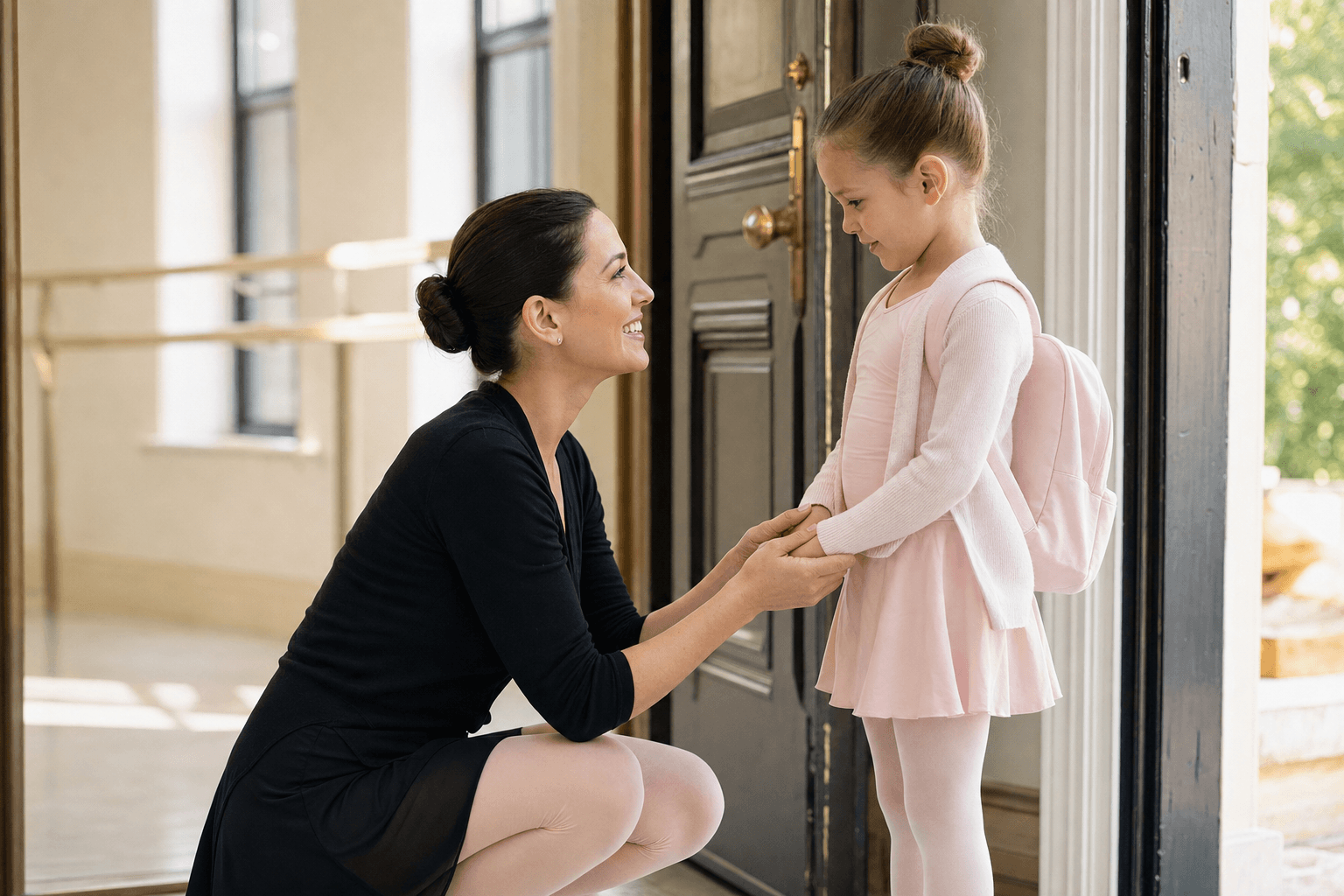
"You must be Eva! Welcome. I'm Miss Sarah, I'll be teaching your class today." Crouch down to their height. Smile at the parent second.
- 03
Walk them through, do not point
Point and they wander. Walk with them and they relax. Show them where to put their coat, where the toilet is, where they will wait.
- 04
Introduce one other family
If another family is already there, introduce them by name. "Sarah, this is Becca, her daughter Lily is in the same class." Friendship begins, and so does belonging.
- 05
Tell the parent exactly what happens next
"I'll take Eva through to the studio in a few minutes. You're welcome to watch from the parents' area or grab a coffee next door. The class is 45 minutes."
From the studio floor
We watched one large studio close ten percent more trials simply by moving their greeting from "behind the desk" to "at the door, with a clipboard, by name". No new marketing. No price change. Just one person, in one different spot, for the first sixty seconds.
Chapter 06
The class experience itself.
You do not need a special show. Run an excellent normal class, with three small adjustments.
The three trial-day adjustments
- 01
Use the trial child's name often
Three to five times in the first ten minutes. Parents who hear their child's name relax instantly.
- 02
Pair them with a buddy
Ask a confident regular quietly before class. "This is Eva, will you show her where we put our shoes?"
- 03
Make one moment of progress visible
A first plié, a clean tap step, a held balance. Notice it. Praise it specifically.
What parents are watching for
Is my child smiling?
Joy is the headline metric. Three smiles and they will ask to come back.
Is the teacher warm?
Eye contact, kindness, patience. Technique matters, warmth matters more.
Are other children kind?
If their child gets included, parents exhale. If their child stands alone, they note it.
Is the studio well run?
Calm starts, clear instructions, named rules. Chaos is a big red flag.
Chapter 07
The handover at the end.
This is where most studios quietly lose families. The class ends, the parent collects, and the moment passes with a wave. It should be the strongest moment of the whole trial.
The 90-second handover
- 01
Walk the child out, do not call the parent in
The teacher escorts the child to the parent personally. A simple signal: we know who your child is.
- 02
Say one specific positive thing
Not "she did brilliantly". Try "Eva picked up the warm-up sequence really quickly". Specific praise carries enormous weight.
- 03
Mention one thing she would learn next
"Next week we'd be working on the pas de chat, she's almost there." Plants the future. Implies belonging.
- 04
Hand over the next-step leaflet
A small printed card with class times, prices, how to enrol. Physical, not digital. They will read it in the car.
- 05
Name the deadline gently
"We have two spaces left this term. No pressure, but I can hold one for you until Friday."
The leaflet that converts
A one-page A5 leaflet, handed over warm, beats any follow-up email. Class options, prices, term dates, your name and phone number. Print one hundred for £30.
Part Three
After the Trial
The follow-up. The hesitant family. The numbers worth tracking. And the templates that make all of it almost effortless.
Chapter 08
The post-trial follow-up.
Most families who decide to enrol have made the decision within 48 hours. Your follow-up either nudges them across the line, or lets the moment cool.
The follow-up timeline
- 01
Same evening · the thank-you
Short, warm, from a person not the studio. "It was lovely to meet Eva. She made me smile when she figured out the arabesque." No ask. Just human.
- 02
Day 2 · the practical follow-up
Confirms how to enrol, repeats the deadline if there is one. "If you'd like to take that space, reply yes and I'll send the link."
- 03
Day 5 · the gentle check-in
Only if no reply yet. "Just checking the timing wasn't right, or if I can answer any questions. No pressure either way."
- 04
Day 14 · the door stays open
Final message. "We'd love to have Eva whenever the timing is right. Door is always open." Earns long-term goodwill.
Tone rules
- Personal, never automated-feeling, even if it is a template
- Reference one specific moment from the trial in the first message
- Sign with a name and a phone number, not a studio email signature
- If they enrol, send a fifth message: a proper week-one welcome
Chapter 09
Closing the family who hesitates.
Some families say yes the same evening. Others sit on the fence for two weeks. Hesitation is almost never about your studio. It is about something specific.
The four common hesitations
Price
Often the loudest objection, rarely the real one. A payment plan or sibling discount usually solves it.
Timing
Wrong day, clash with another activity. Offer alternatives quickly. "We run the same class on Tuesday at 4pm."
Child seemed unsure
Almost universal at age four to six. "Most first trials look like that. By week three they're the loudest in the studio."
They are comparing
They have a trial booked elsewhere. Do not knock the competition. Reinforce your specifics: class sizes, named teacher, results.
Scripts that work
If price. "Understandable. We offer a sibling discount and a pay-by-the-month option. Would either help?"
If timing. "We have flexibility on this. If Wednesday doesn't work, the same class runs Saturday at 10am. Hold a space there instead?"
If the child seemed unsure. "So normal. The second class is almost always the moment. Take a second trial on us, decide then."
Chapter 10
Tracking trial-to-enrol conversion.
You cannot improve what you cannot see. Three numbers tell you almost everything about the health of your trial process.
The three numbers
Enquiry to trial booked
Of every ten enquiries, how many turn into a confirmed, attended trial? Aim for 70 percent.
Trial to enrolled
Of every ten trials that happen, how many enrol? Aim for 60 to 75 percent.
Enquiry to enrolled
The headline. The multiplication of the two above. Aim for 45 to 55 percent.
How to track it without software
- A spreadsheet with five columns: date enquired, name, class, trial date, enrolled yes/no
- A sixth column for source (Google, Facebook, friend, walk-in)
- Review monthly, not weekly. Three months gives you a real picture.
Quarterly review
Once a quarter, look at your spreadsheet. Where is the biggest leak? That is your one thing to fix. After a year, your conversion rate will be unrecognisable.
Worksheet
Trial day checklist.
Print this. Stick it on the studio noticeboard. Use it the morning of every trial, every term.
The day before
- Day-before email or WhatsApp message sent
- Teacher knows the trial child's name and any notes
- Buddy student briefed before class
- Welcome leaflet printed and at the door
On the day
- Someone is at the door ten minutes before start
- Family greeted by name within thirty seconds
- Trial child introduced to one other family
- Teacher uses the child's name three times in the first ten minutes
- One moment of progress noticed and praised
At the handover
- Teacher walks the child out to the parent personally
- One specific positive comment about the class
- One mention of what they would learn next
- Welcome leaflet handed over warmly
- Gentle deadline named if relevant
After
- Same-evening thank-you message sent
- Spreadsheet updated (source, attended, enrolled)
- Day 2 and day 5 follow-ups scheduled
Templates
The pre-trial email templates.
Copy. Tweak. Send. Replace the bracketed bits and you have a working sequence in twenty minutes.
Email 1 · The warm confirmation
Subject: Welcome to [Studio Name] · [Child]'s trial is booked
Hi [Parent first name],
Lovely to hear from you. I've booked [Child] in for our [class name] trial on [day] at [time]. The class runs for [duration] and is taught by [Teacher name].
I'll send a quick guide a few days before, with what to wear, where to park, and what to expect. Any questions, just reply.
[Your name]
[Studio Name] · [Phone]
Email 2 · The practical guide
Subject: A quick guide for [Child]'s first class on [day]
Hi [Parent first name], quick note ahead of [Child]'s trial on [day] at [time].
What to wear: [specific to discipline]
Where to park: [link to exact spot]
Which door: [description, ideally a photo]
Arrive: ten minutes early
Who'll meet you: I'll be at the door looking out for you.
The class is 45 minutes. Bring a water bottle, nothing else.
See you [day],
[Your name]
Templates
The follow-up templates.
Email 3 · The day-before nudge
Subject: See you tomorrow, [Parent first name]
Hi [Parent first name], looking forward to seeing you and [Child] tomorrow at [time]. I'll be at the door from ten minutes before.
Any last-minute questions, message me on [number].
[Your name]
Same evening · the thank-you
Subject: Lovely to meet you and [Child] today
Hi [Parent first name], it was so lovely to meet you both today. [One specific moment: "She made me laugh when she got the hang of the arabesque"]. Hope you had a good evening.
Whenever you're ready, just shout. No rush.
[Your name]
Day 2 · the practical follow-up
Subject: [Child]'s next steps with [Studio Name]
Hi [Parent first name], if you'd like to take a space in [day, time] [class name] this term, you can enrol here: [link].
We have two places left, so I can hold one until [Friday] if helpful. Either way, thanks for trying us. Any questions, I'm here.
[Your name] · [Phone]
Templates
Scripts for the moments that matter.
Three short scripts. Print them on a card, keep them by the studio door, run them every time.
The greeting (first 30 seconds)
[Kneel down to the child's height, smile warmly]
"You must be [child's name]! Welcome to [Studio]. I'm [your name], I'll be looking after you today. We're so pleased you came."
[Stand up, smile at the parent]
"[Parent first name], lovely to meet you. Let me show you both where we go."
The handover (last 90 seconds)
[Walk child out to parent]
"Here she is. [Child] did really well today. [One specific positive moment]. Next week we'd be moving on to [next thing], she's already almost there.
Here's a little welcome leaflet with everything you need. We have [two] spaces left in that class for this term, so no rush, but if you'd like one I can hold it for you until [Friday]. Either way, lovely to meet you both."
If they say "we'll think about it"
"Of course, take your time. I'll drop you a message in the next day or two with the practical details, and you can take a space whenever feels right. No pressure at all. Have a lovely weekend."
Worksheet
Your trial conversion tracker.
Three months of focus on this one set of numbers will change your enrolment more than any new marketing campaign. Write your starting numbers below, then revisit in 90 days.
Enquiries, trials, enrolments
What I changed and what shifted
What worked, what to keep, what to drop
The one number to move
If I could move one of these three numbers by ten percent in the next 90 days, the most valuable one would be: